Communication

Communication means sending and receiving messages. We communicate in many ways every day, including speech, writing, road signs and warning sounds. Here you will learn simple ways to send messages and use ciphers.
 Ways of communicating.
Media
A medium is a means of communicating or transmitting information. Today, the internet is among the most widely used. Other familiar media include radio, television, posters and newspapers. You also use media when you telephone, send text messages or post letters. Scouting and Guiding uses these media too. Most local groups have a website or social media channels. Many also send out a printed magazine, such as the Swiss Guide and Scout Movement's national SARASANI magazine.
 Examples of communication media.
Signalling Methods
To transmit a message, you need a signal the receiver can detect. Signals can travel in different ways. The clearer they are, the easier they are to understand. Contrast with the background helps: you are easier to see standing on a hill, for example. Light signals stand out at night or against a dark background; a torch is one way to make them. The table gives an overview.
| Signal | Time of day | Equipment | Range |
|---|---|---|---|
 Flag. |
Day | Flags or discs | 500 m; up to 2 km with binoculars |
 Signalling mirror. |
Day | Signalling mirror | Up to 20 km |
 Torch. |
Night | Torch | 1–3 km, depending on brightness |
 Signal lamp. |
Night | Morse signal lamp | Up to 20 km |
 Horn. |
Day/night | Whistles and horns | About 500 m; strongly affected by wind and background noise |
 Morse key. |
Day/night | Morse key | Depends on cable length |
Trail signs
Natural materials such as stones, sticks and leaves let you leave messages for other Scouts and Guides. Recognising trail signs takes practice, so make them large and clear, especially in undergrowth.
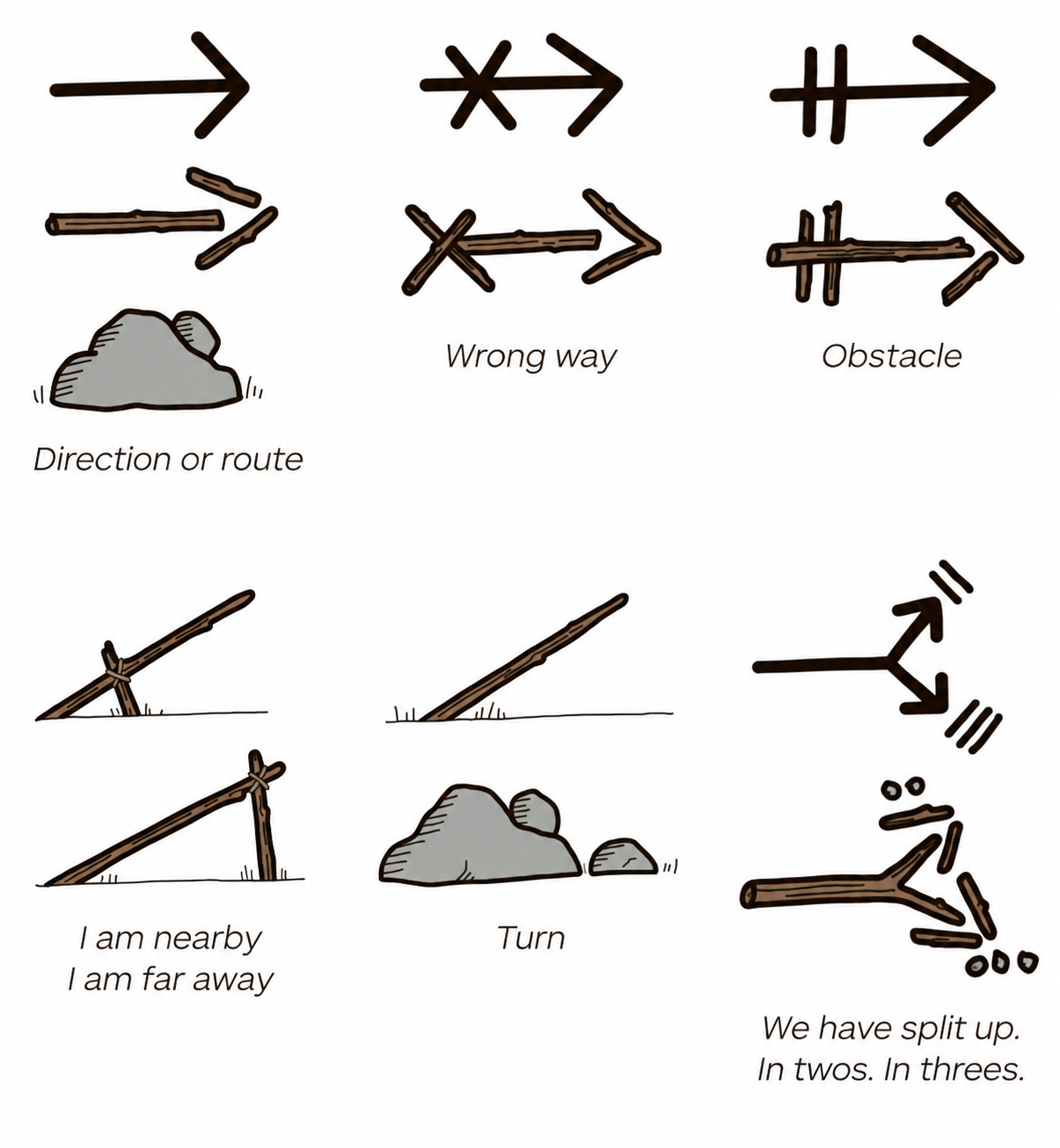 Trail signs, sheet 1.
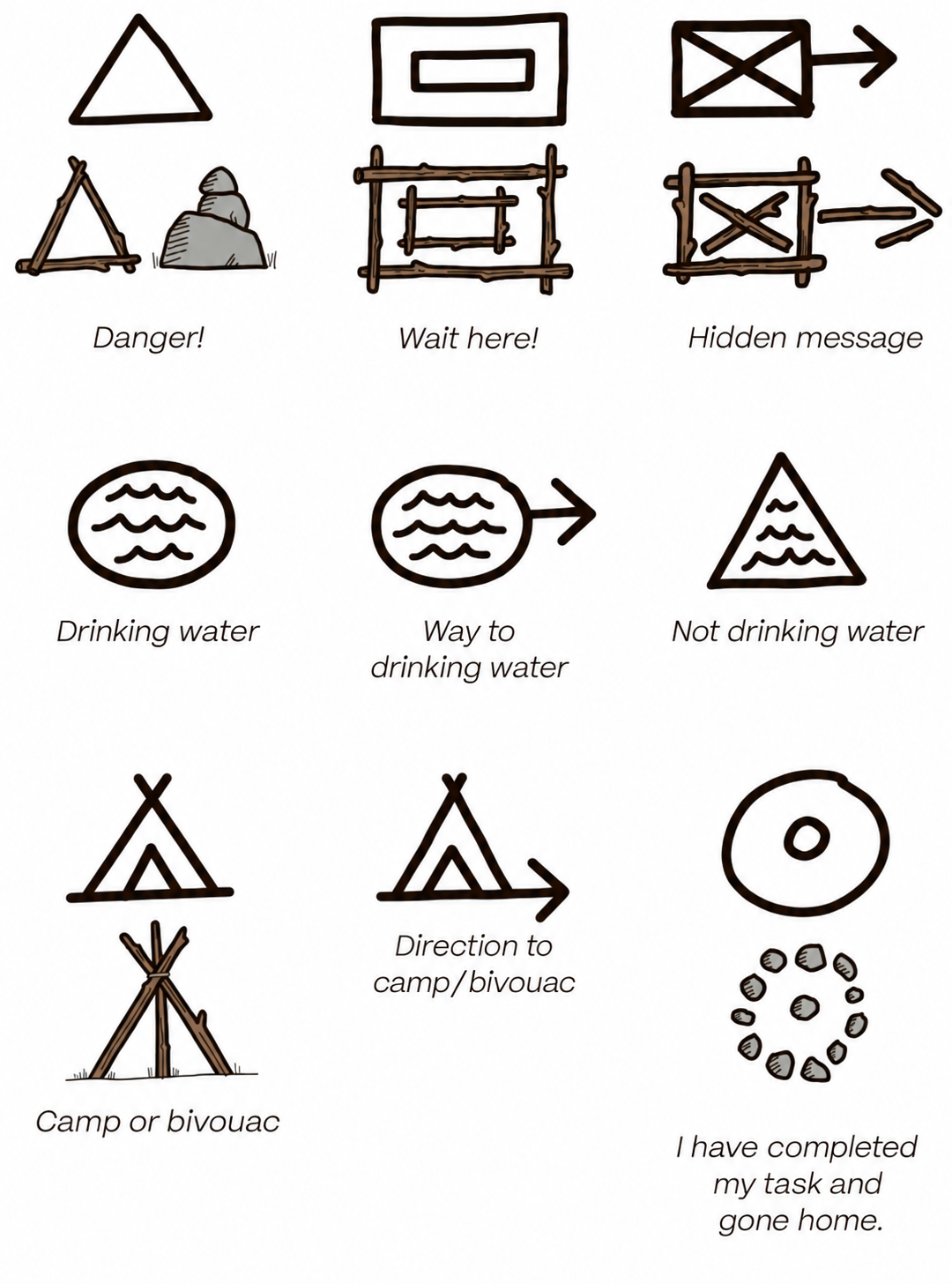 Trail signs, sheet 2.
Morse code
Morse code sends messages as dots and dashes:
- The basic letters A–Z use one to four signals.
- Digits use five signals.
- Punctuation and special signals use other combinations, often six signals.
Use the reference table below to learn the international Morse alphabet. Say ‘dit’ for a dot and ‘dah’ for a dash to practise each letter's rhythm.
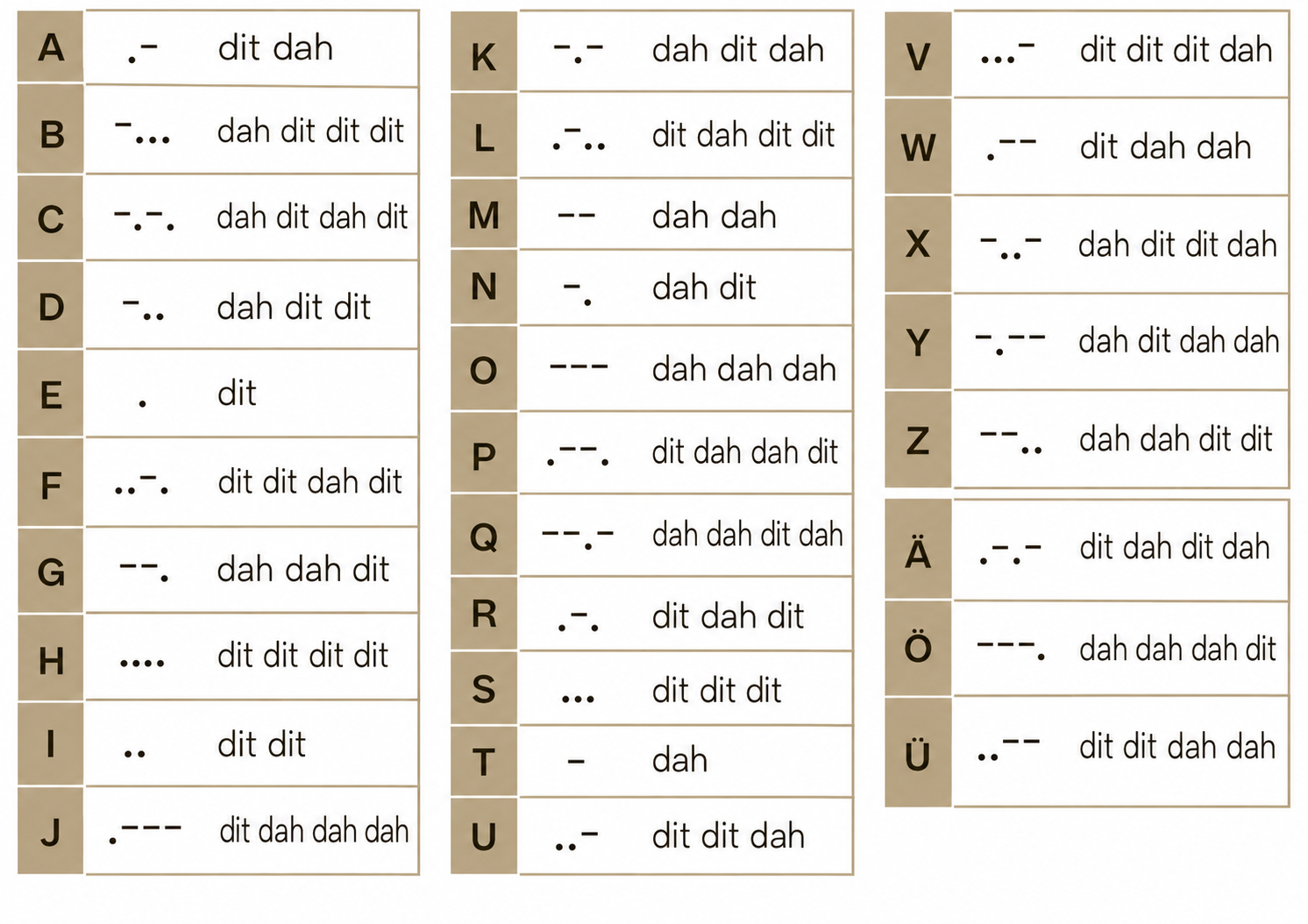 Morse alphabet, sheet 1.
 Morse alphabet, sheet 2.
| Letter | Code | Letter | Code | Digit | Code |
|---|---|---|---|---|---|
| A | .- | N | -. | 0 | ----- |
| B | -... | O | --- | 1 | .---- |
| C | -.-. | P | .--. | 2 | ..--- |
| D | -.. | Q | --.- | 3 | ...-- |
| E | . | R | .-. | 4 | ....- |
| F | ..-. | S | ... | 5 | ..... |
| G | --. | T | - | 6 | -.... |
| H | .... | U | ..- | 7 | --... |
| I | .. | V | ...- | 8 | ---.. |
| J | .--- | W | .-- | 9 | ----. |
| K | -.- | X | -..- | ||
| L | .-.. | Y | -.-- | ||
| M | -- | Z | --.. |
For a simple game, you can agree that a dot means “understood” and a dash “not understood”.
With sound, a short tone is a dot and a long tone a dash. With light, use short and long flashes. Keep a steady rhythm so the two are easy to distinguish. All durations are multiples of a dot:
- A dash lasts three dots.
- The gap between dots and dashes within a character lasts one dot.
- The gap between letters lasts three dots.
- The gap between words lasts seven dots.
The illustration shows these timings:
 Morse signal lengths and pauses.
A Morse decoding tree helps you read messages quickly. Start at the top centre and follow the appropriate colour for each dot or dash.
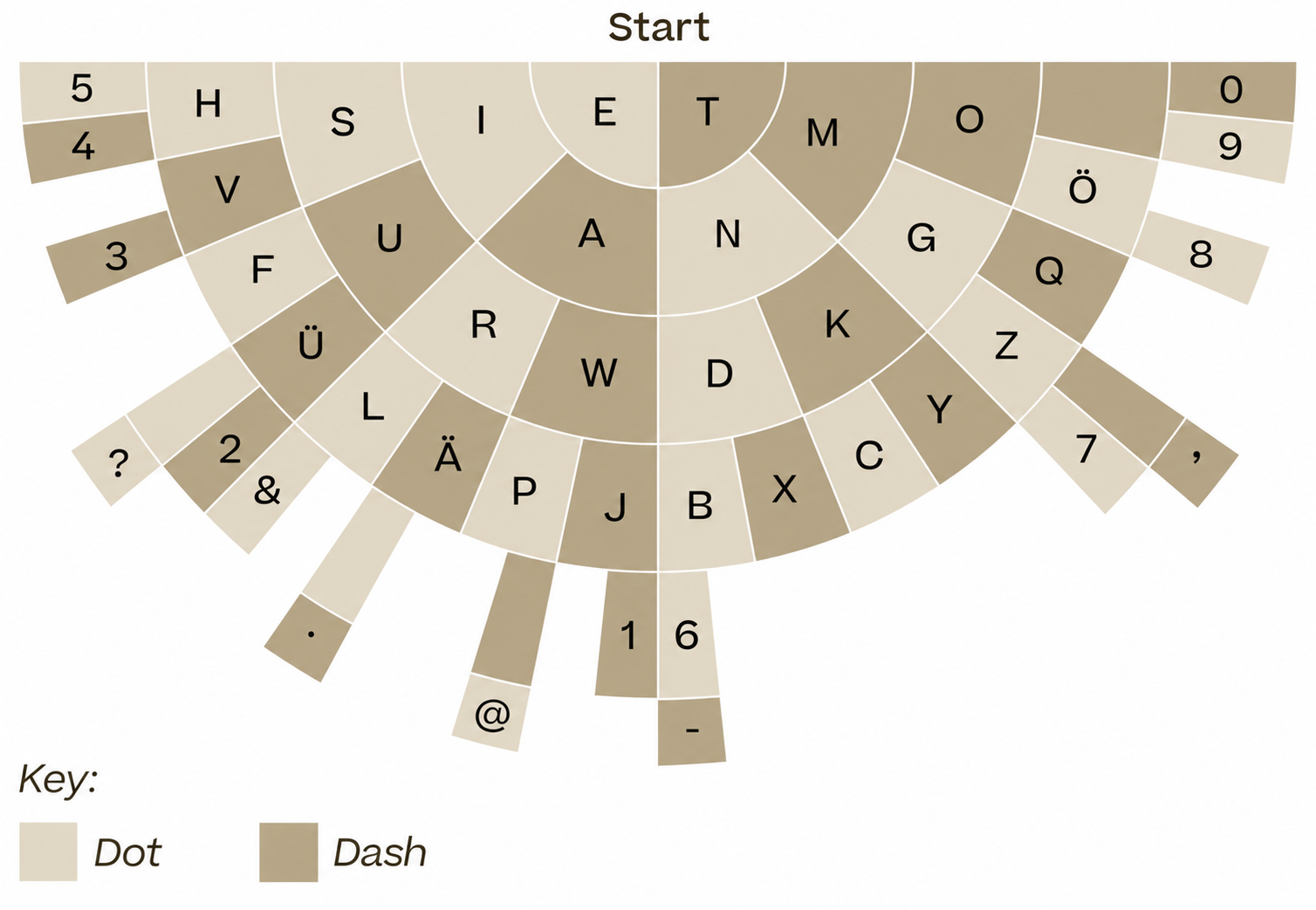 Morse decoding tree.
When writing Morse, separate letters with one slash and words with two. This makes their boundaries clear. This example reads “IT WORKS”:
../-//.--/---/.-./-.-/...//
You can also send Morse with flags, using different positions for dots and dashes.
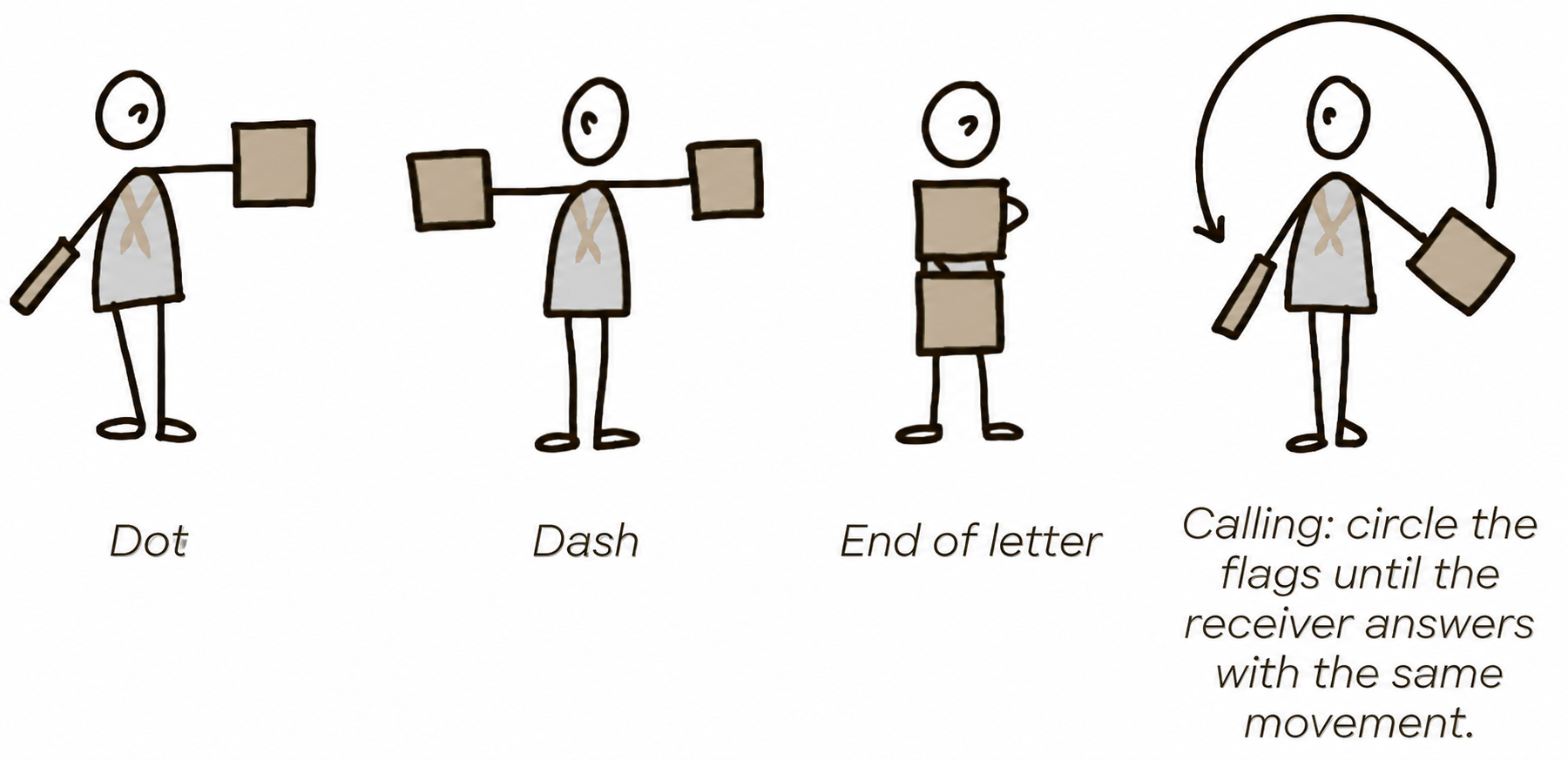 Flag positions for Morse signalling.
Semaphore
Semaphore represents letters through different arm positions. It takes more practice than Morse, but can be sent much faster. Arm positions are based on 45° intervals. To make your message clear, return to the rest position between characters and hold each signal steadily and precisely. To send a number in the system shown, begin with the number sign, send the digits and finish with the number sign.
Use sticks or flags to extend the range. With either system, abbreviations and short messages help.
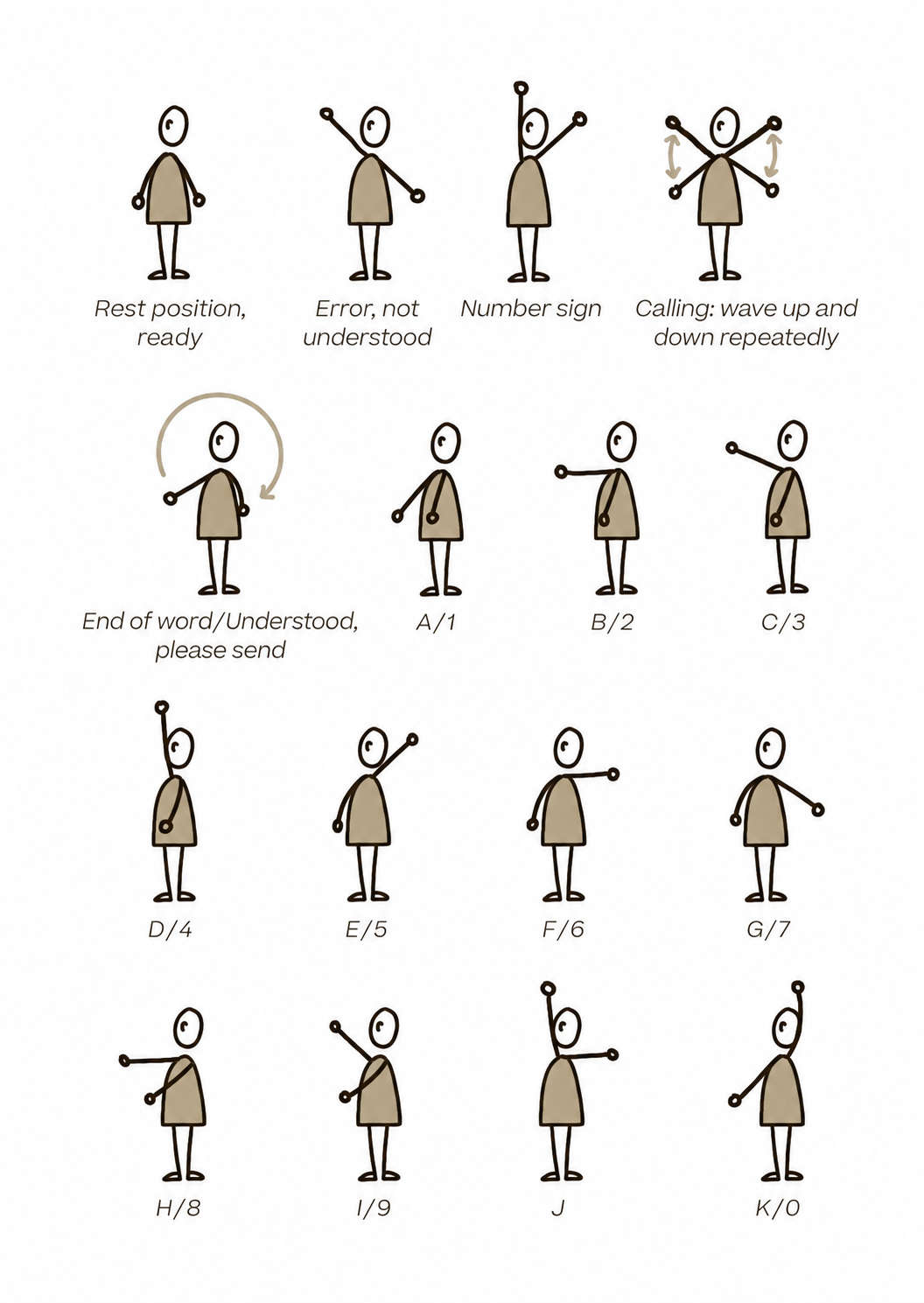 Semaphore alphabet, sheet 1.
 Semaphore alphabet, sheet 2.
Other ways of communicating
You have now met several signalling systems. Combine them with different media to make communication easier or faster, for example a homemade tin-can telephone. Experiment to see what works. The important thing is that the receiver can understand the message.
 A tin-can telephone.
JOTA-JOTI Worldwide
JOTA stands for Jamboree on the Air, and JOTI for Jamboree on the Internet. JOTA-JOTI is a worldwide gathering using radio and the internet. It is Scouting's largest digital and radio event, held each year on the third weekend in October. Scouts and Guides communicate around the world from their meeting places. Ask your leaders if you would like to take part.
 JOTA-JOTI.
The phonetic alphabet
The international phonetic alphabet is used in radio communication worldwide, including aviation and JOTA-JOTI. It makes spelling words clearer by assigning a word to each letter, avoiding confusion between similar-sounding letters such as F and S:
- Alfa, Bravo, Charlie, Delta, Echo, Foxtrot, Golf, Hotel, India, Juliett, Kilo, Lima, Mike, November, Oscar, Papa, Quebec, Romeo, Sierra, Tango, Uniform, Victor, Whiskey, X-ray, Yankee, Zulu.
For example, “CAMP” is spelled Charlie Alfa Mike Papa.
Ciphers
Enciphering a message keeps its contents secret. If the message is invisible or unintelligible to others, only its sender and intended receiver can read it.
 Writing with invisible ink.
Invisible inks
The simplest way to hide a message is to hide the fact that there is a message at all. Invisible ink is one option. Write with orange, lemon or onion juice and let it dry: the writing becomes invisible. The receiver can reveal it with gentle heat. Keep paper away from open flames and use a safe heat source with adult supervision. Salt or sugar solutions and egg white diluted with water can also become visible when warmed.
Alternatively, write with a white wax candle. Paint over the paper with watercolour: the paint sticks only where there is no wax.
Ciphers with a text key
You can scramble a message so it makes no sense to an outsider. The receiver needs the right key to make it readable again. One simple method shifts the alphabet. Shift two places and A becomes C, B becomes D, and so on. CAMP becomes ECOR. To decode it, shift each letter two places back.
A homemade cipher wheel makes this easier:
 A letter-shifting cipher wheel.
Other methods swap letters or reverse whole words. The receiver must have the key. Here are some ideas; you can invent your own too.
Inserting, deleting and moving
Add an extra letter after each real letter, or an extra word after each real word. Removing every second letter from this example reveals “CAN YOU READ THIS?”:
- CZAZNZ YZOZUZ RZEZAZDZ TZHZIZSZ?
Alternatively, remove every third letter and append the removed letters to the end. “THISISEASY” becomes:
- THSIEAYISS
Letter grid
Write a message into a grid from left to right. Fill any empty spaces with random letters. Reading down the columns scrambles it. A receiver who knows the grid dimensions can reverse the process. “MEET ME AT THE TENT IN TWO HOURS”, becomes MEEIHEATNOETETUTTNWRMHTOS.
| M | E | E | T | M |
| E | A | T | T | H |
| E | T | E | N | T |
| I | N | T | W | O |
| H | O | U | R | S |
Ciphers with a physical key
For these methods, both people need the same physical object. Only someone with that key can write or read the message.
Strip cipher
Wrap a long paper strip around a cylinder and write across the turns. Only someone with a cylinder of the same diameter can read it easily.
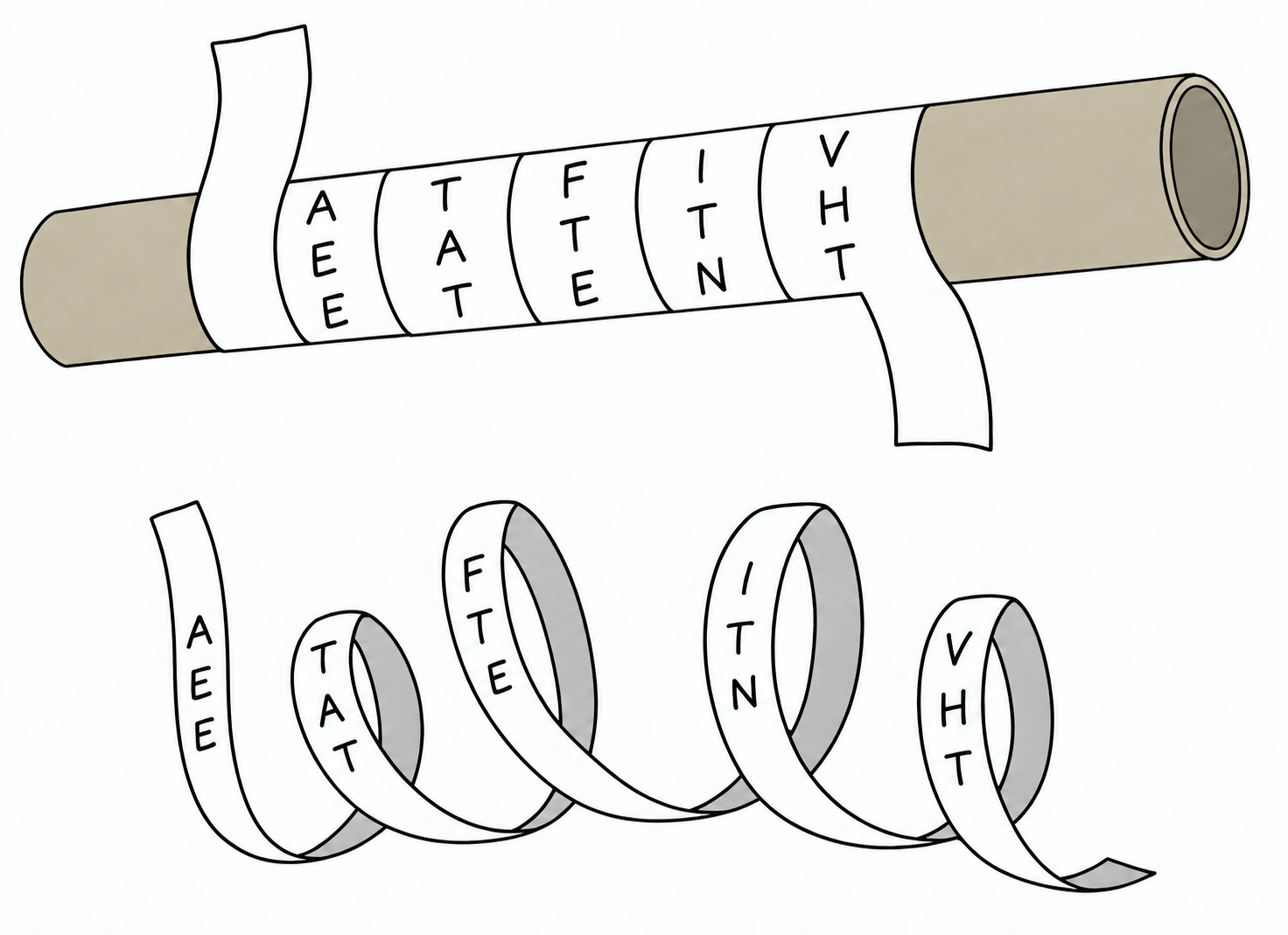 A strip cipher wrapped around a cylinder.
Grid-and-overlay cipher
Fill a grid with random letters. Lay tracing paper or clear film over it and draw a line connecting the letters of your message. Give the receiver the overlay. With an identical letter grid, they can follow the line and decode the message.
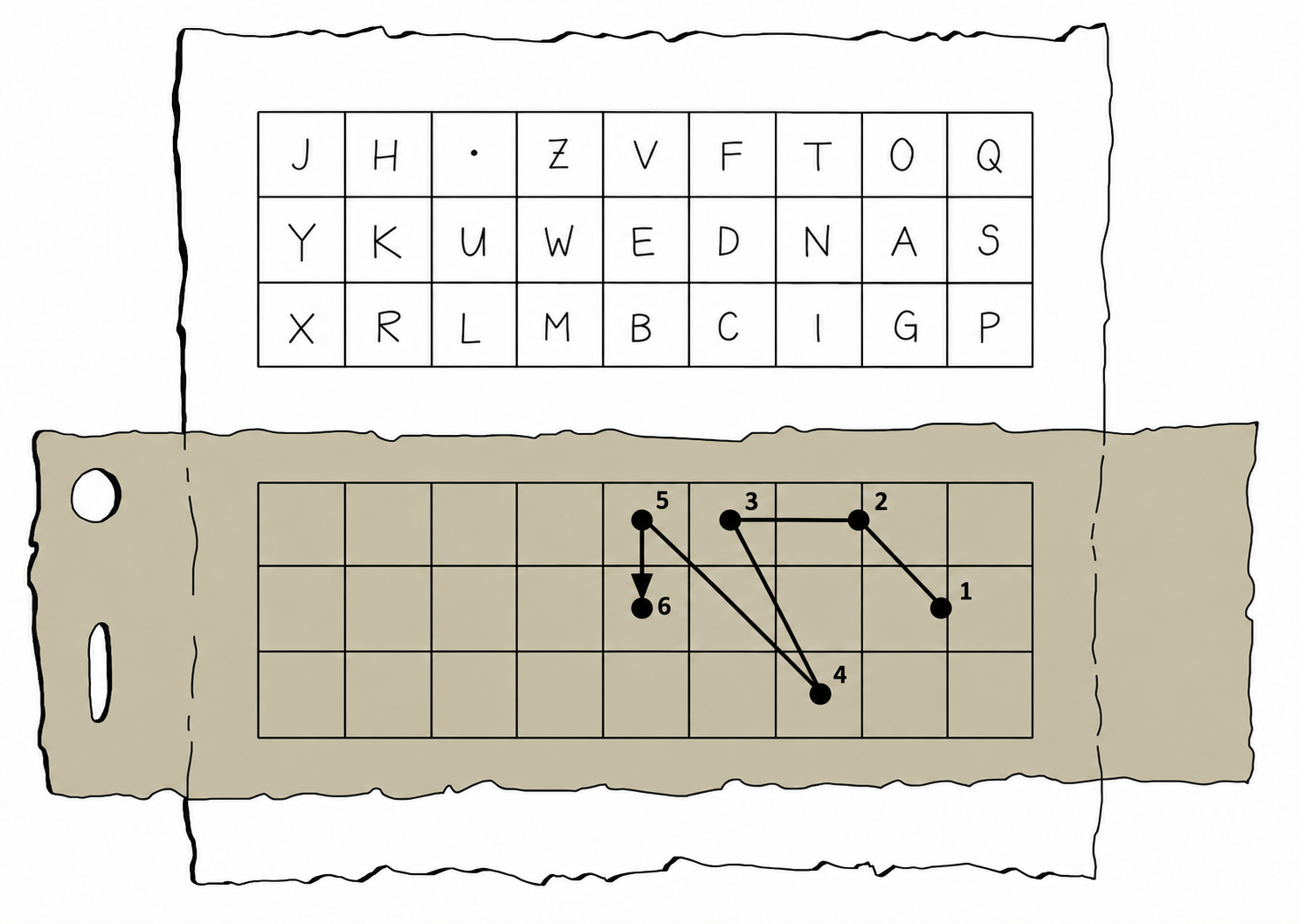 A letter grid and transparent decoding overlay.
Codebreaking and Combining Methods
With patience and skill, you may decode a message without knowing its key. Start by looking for patterns:
- Short, common words such as “the”, “and”, “a” and “is”.
- Common letter combinations such as “th”, “sh”, “ch” and “qu”.
- Letter frequency. In English, letters such as E, T, A, O, I and N are especially common. Frequencies differ between languages, so German patterns do not transfer directly.
These patterns may reveal the kind of cipher being used. Try reversing the method you suspect. If you are right, the text becomes readable. More elaborate ciphers are harder to solve. For games, combining methods makes a puzzle harder; these simple ciphers do not provide modern security. You can invent your own, but remember that your receiver must still be able to decode them.
- Can you work out what this sentence says? UIF USFBTVSF JT CFIJOE UIF UFOU
Secret Alphabets
In a secret alphabet, familiar letters are replaced with new symbols known only to the sender and receiver. A simple example uses picture symbols like those shown here:
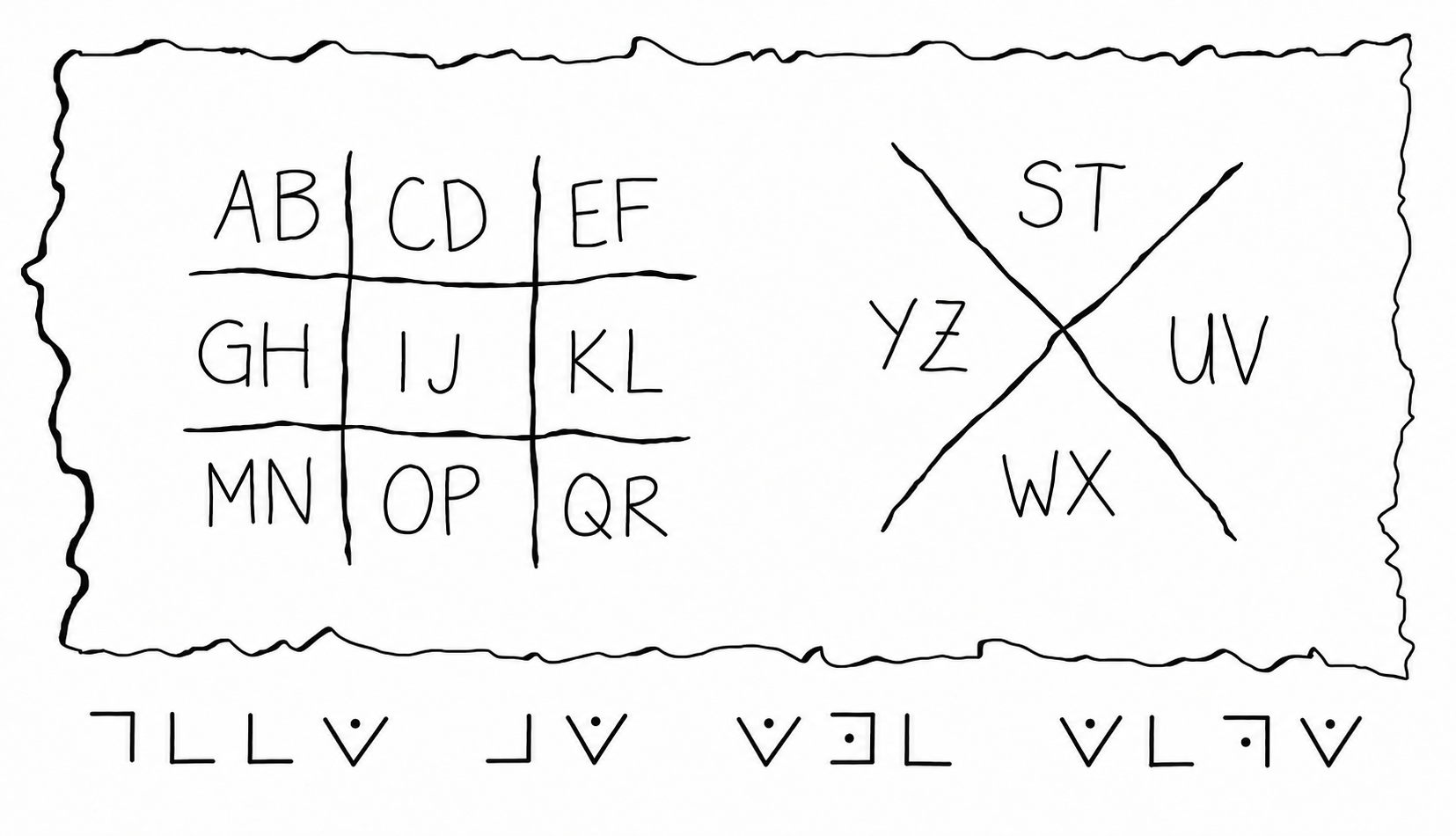 An example of a secret picture alphabet.
Secret Languages
You can turn a language into a secret language by changing it. Replace certain words with code words and you have your own system. Another option replaces vowels: change every A to ANAFA, every E to ENEFE, and so on. Applying the rule takes practice, but it is worthwhile: people who do not know the system will find your new language hard to understand.