Scouting and Guiding

History
The founder of Scouting was Sir Robert Stephenson Smyth Baden-Powell, known as B-P (or BiPi in German). He was born in London on 22 February 1857. This date is celebrated around the world as Thinking Day.
B-P was an army officer in the British colonies, where he trained young people as scouts. They helped the soldiers with simpler tasks. He followed the principle of learning by doing. Through this experience, he realised that young people could take on responsibility too. This gave him the idea of founding the Scout movement. In 1907, B-P organised the first Scout camp on Brownsea Island in England. This is therefore considered the year in which the Scout movement was founded. With the help of his sister Agnes, he founded the Girl Guides in 1910. Later, B-P's wife, Olave St Claire Baden-Powell, took over the leadership of the Girl Guides. By coincidence, Olave shared B-P's birthday.
 Olave
 B-P
B-P died in Kenya on 8 January 1941. The trail sign on his gravestone, a circle with a dot in the centre, became an internationally recognised Scouting symbol.
It means: “I have completed my task and gone home.”
 B-P's gravestone with the trail sign for going home
International Scouting and Guiding
The World Organization of the Scout Movement (WOSM) and the World Association of Girl Guides and Girl Scouts (WAGGGS) are the umbrella organisations for Scouting and Guiding around the world. The Scout and Guide movement spans 171 countries and has more than 67 million members worldwide.
Two of the six international Scout and Guide centres run by WAGGGS and WOSM are in Switzerland: Kandersteg International Scout Centre (KISC) in Kandersteg and Our Chalet in Adelboden.
 WOSM logo
 WAGGGS logo
The Fleur-de-Lis and the Trefoil
The three leaves of the fleur-de-lis and the trefoil symbolise the search for meaning and purpose in life, responsibility towards others, and ongoing reflection on ourselves. The line in the central leaf represents a compass needle, which is meant to guide Scouts and Guides in the right direction. The circle around the symbols represents the bond between all members of the Scout and Guide movement. The two stars remind us of the Law and Promise and their importance to Scouting and Guiding. The trefoil represents the World Association of Girl Guides and Girl Scouts, while the fleur-de-lis represents the World Organization of the Scout Movement.
The Swiss Guide and Scout Movement belongs to both world organisations, so its logo includes both symbols. The fleur-de-lis represents the boys and men in our association, and the trefoil represents the girls and women.
 Logo of the Swiss Guide and Scout Movement
Scouting and Guiding in Switzerland
Soon after Scouting was founded in England, the first Scout and Guide groups came together in Switzerland. This led to the formation of the Swiss Scout Federation (Schweizerischer Pfadfinderbund, SPB) and the Federation of Swiss Girl Guides (Bund Schweizerischer Pfadfinderinnen, BSP). Both helped to establish Youth and Sport (Jugend und Sport, J+S) in the 1970s. In 1987, the SPB and BSP merged to form what is now the Swiss Guide and Scout Movement (SGSM; Pfadibewegung Schweiz, PBS).
Scouting and Guiding in Switzerland is divided into five age sections: Beavers, Brownies and Cub Scouts, Scouts and Guides, Venture Scouts, and Rovers. This structure provides the basis for an age-appropriate programme. Pfadi trotz Allem (PTA) offers adapted activities for children and young people with disabilities. In this way, Scouting and Guiding provides a programme that reflects the development and needs of all young people. Former Scouts and Guides can stay involved and connect with others through the Silver Scouts or local associations of former Scouts and Guides. This allows them to remain part of Scouting and Guiding.
Our Values
Beaver Law
We Beavers…
- … want to make friends and play with them.
- … are curious and want to discover new things.
- … enjoy nature and take good care of it.
Cub Scout and Brownie Law
We want to…
- … care for one another, help one another and learn from one another.
- … look after nature and the environment.
- … discover new things using our eyes, ears, nose, mouth and hands.
Cub Scout and Brownie Promise
I want to be part of the Cub Scouts and Brownies. I will try to do my best and follow our Law.
Scout and Guide Law
We Scouts and Guides want to…
- … be open and truthful.
- … understand and respect other people.
- … find joy and pass it on.
- … share with one another.
- … lend a helping hand.
- … care for nature and every living thing.
- … make our own decisions and accept responsibility.
- … meet challenges with confidence.
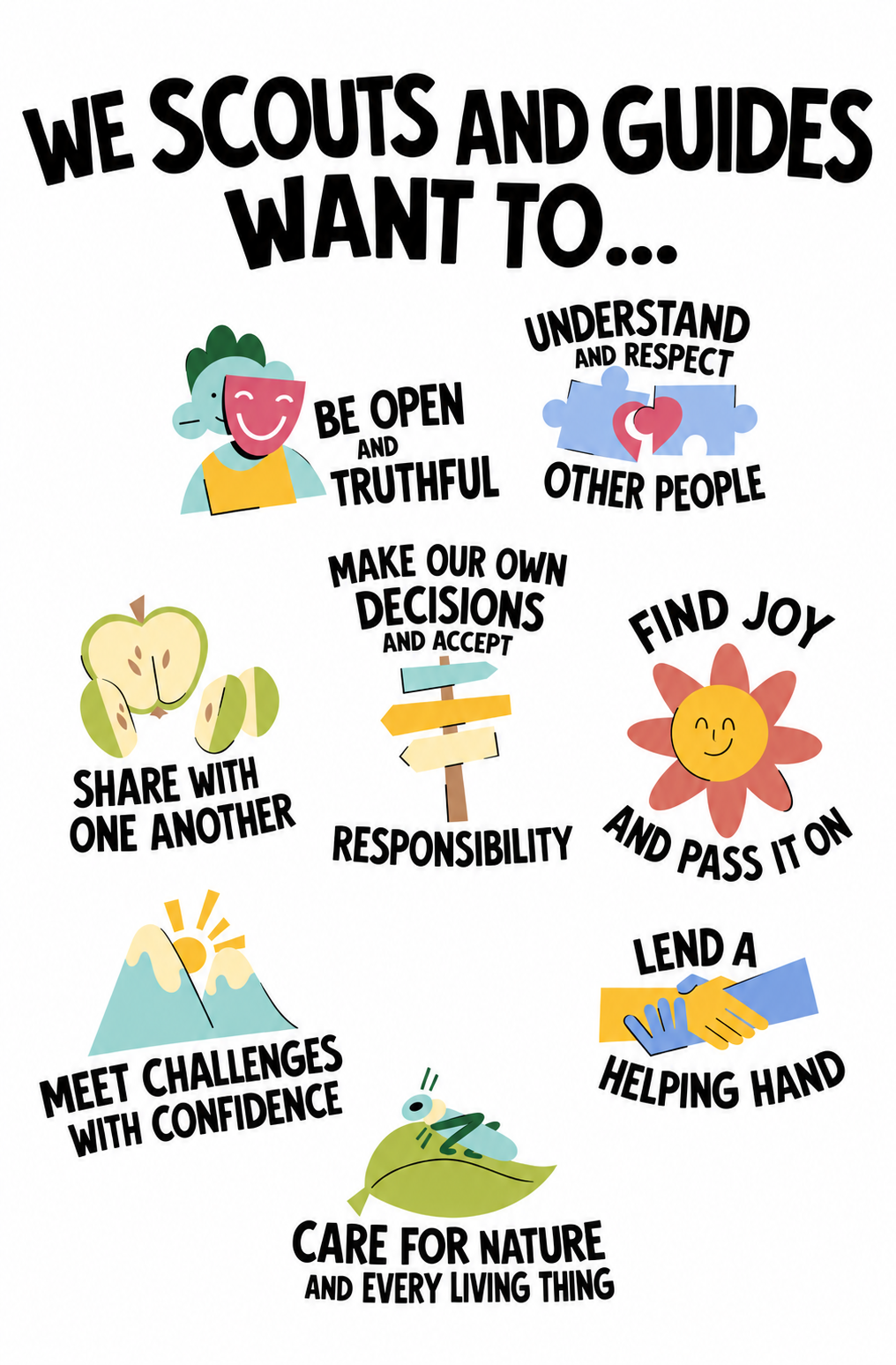 Scout and Guide Law
This Scout and Guide Law connects us with Scouts and Guides around the world.
We add our own points, both for ourselves and for our group:
- …
- …
Joining Promise
I want to contribute to my group and do my best to live by the Scout and Guide Law.
I ask God and all of you to help me do so.
or
I ask all of you to help me do so.
Scout and Guide Promise
I promise to do all I can to
- keep reflecting on the Scout and Guide Law,
- seek meaning and purpose in my life,
- play an active part in every community I belong to,
- …
Trusting in God and together with all of you, I will try to live by this Promise.
or
Together with all of you, I will try to live by this Promise.
The Scout and Guide Law and Promise also apply to Venture Scouts and Rovers, with the same wording.
 Cub Scout and Brownie Promise badge
 Scout and Guide Promise badge
 Venture Scout Promise badge
 Rover Promise badge
The Promise badges for Brownies and Cub Scouts, Scouts and Guides, Venture Scouts, and Rovers.