First Aid

 Being prepared to help.
If an accident happens, it helps to know how to respond. Fortunately, most incidents are minor: a few reassuring words and an occasional plaster are often enough. Reduce risks by taking care, behaving responsibly and following the relevant rules.
This section explains how to respond in an emergency and recognise and treat minor injuries.
If something happens, two things matter from the start:
- Stay calm and reassure the injured person.
- Give first aid only if it is safe for you to do so. Protecting yourself comes first.
Look, Think, Act
 The traffic-light approach: look, think, act.
The traffic-light approach helps you keep an overview and act correctly in an emergency.
Look — assess the situation
- Stay calm!
- What has happened?
- Who is affected, and how many people?
Think — recognise dangers
- Where are the dangers?
- How can I remove them?
- Are equipment or other helpers available?
- How can they help?
- Who will do what?
Act — give the right help
- Make the accident scene safe.
- Move the injured person out of danger if it is safe and necessary.
- Call the emergency services.
- Care for and monitor the injured person.
- Protect them from the weather.
Calling for Help
The most important emergency numbers in Switzerland are:
- Police: 117
- Ambulance: 144
- Fire service: 118
- Rega air rescue: 1414
- European emergency number: 112 (also valid in Switzerland)
- Tox Info Suisse: 145 (poisoning advice)
- Pfadi-Helpline: 0800 22 36 39; from abroad: +41 58 058 88 99
The emergency dispatcher will guide you through the call. They will need to know:
- Where is the emergency?
- Who is calling?
- What is your callback number?
- What exactly happened?
- When did it happen?
- How many people are affected or injured?
- Anything else? Are there particular dangers?
If possible, the dispatcher will stay on the line until help arrives. Have someone guide the rescuers to you so they can find you quickly.
 Calling the emergency services.
First Aid for Injured People
This flowchart helps you assess an injured person. Life-threatening bleeding needs immediate control. Ask other helpers to call for help and assist at the same time where possible.
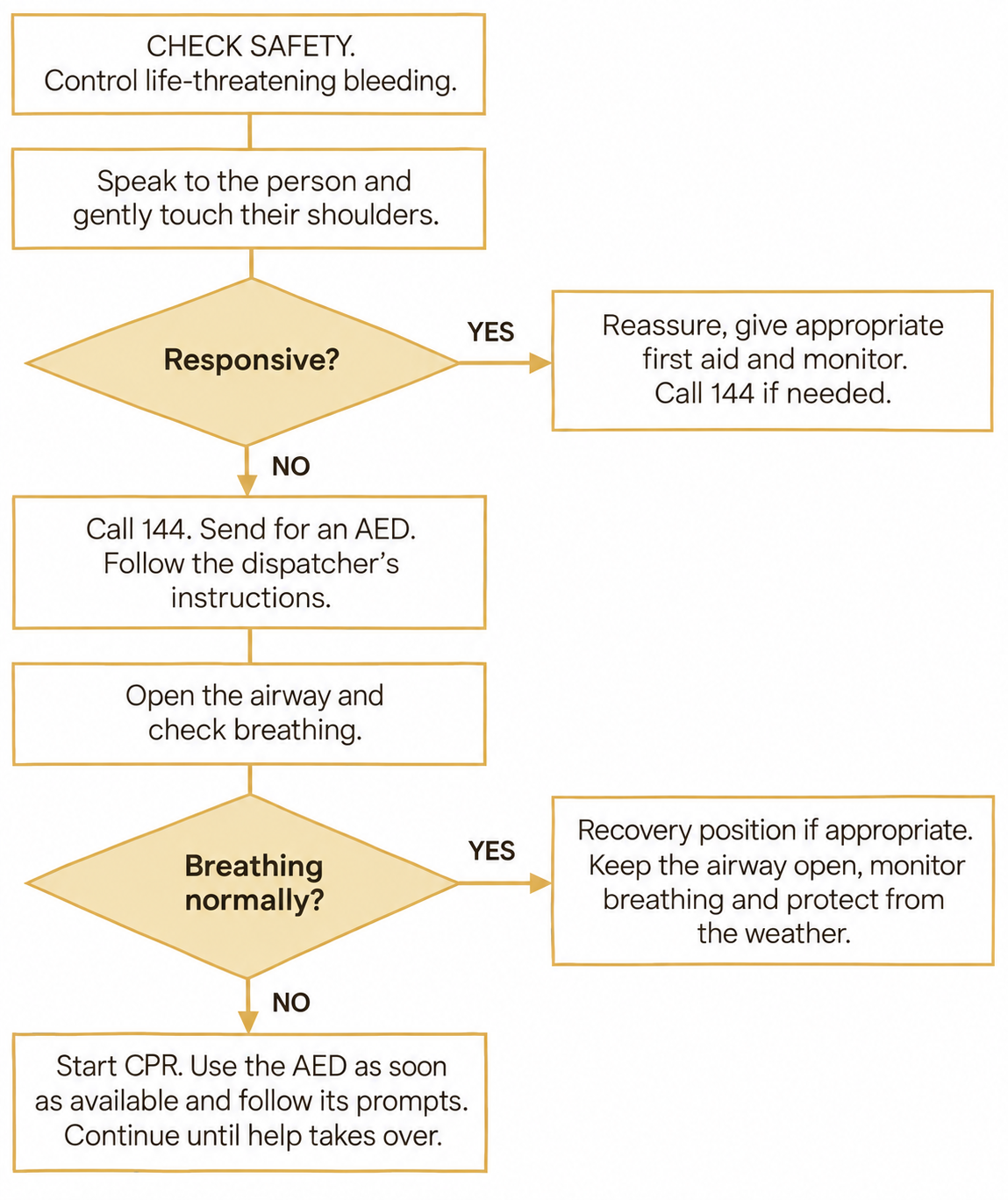 First-aid assessment flowchart.
If a person is unresponsive, call 144 and follow the dispatcher's instructions. If breathing is absent or abnormal, begin CPR and use an AED as soon as one is available. The recovery position is for an unresponsive person who is breathing normally, where moving them is appropriate. Continue checking breathing while waiting for help.
Distress Signals
Use these signals to attract attention. Only use them in an emergency, never for fun.
- General distress: SOS (• • • / — — — / • • •).
- In water: slap the surface with your flat hand.
- In the mountains: give six identical signals per minute, for example shouts, whistles or flashes of light.
- Rescue helicopter: raise both arms to form a Y if you need help. To indicate that you do not need help, hold one arm up and the other down, forming a diagonal N.
Moving Someone out of Danger
The Rautek rescue grip can help move someone from immediate danger to a safer place. Take care not to injure yourself. Do not exceed your strength, and keep your back straight. Move an injured person only when the situation is life-threatening.
 The Rautek rescue grip.
How it works: bend one of the person's forearms across their body and reach both your arms under their armpits. Hold their bent forearm and move backwards to pull them to safety. If another helper is available, they can carry the legs. In that case, move in the direction the rescued person is facing.
The Recovery Position
The recovery position is used for an unresponsive person who is breathing normally, where it is appropriate to move them. It helps keep the airway open and allows vomit or blood to drain from the mouth. Call 144. Remove glasses and bulky objects from pockets and loosen tight clothing around the neck. Protect the person from wet, cold or heat, for example with an emergency blanket.
Roll the person towards you and position them securely so they cannot roll away. Keep the airway open and angle the mouth downwards so fluid can drain. Continue monitoring breathing. Move the person as gently as possible. If you suspect a spinal injury, avoid unnecessary movement and follow the emergency dispatcher's instructions; maintaining breathing takes priority.
If breathing is absent or abnormal, begin CPR rather than using the recovery position.
 Positioning a normally breathing, unresponsive person on their side.
Injuries, Illnesses and Accidents
The following sections describe injuries, illnesses and accidents and the first aid they may require. Wear gloves when treating bleeding to protect both yourself and the injured person from infection.
 A graze.
Small cuts and grazes
- Cause: damage to the skin and blood vessels.
- Signs: slight bleeding.
- Action: clean the area around the wound, carefully disinfect as appropriate and cover with a plaster or gauze. A suitable wound ointment may be used for grazes. Wound-closure strips may help with a small, clean cut whose edges gape. Work hygienically and wear gloves to reduce infection risk.
Blisters
- Cause: friction and moisture in shoes or from using tools.
- Signs: a fluid-filled blister, usually on the hands or feet.
- Action: leave it intact to heal. A blister plaster can reduce friction. If a blister opens, clean it and cover it with an appropriate absorbent dressing. Do not deliberately burst it yourself.
Insect stings
- Cause: an insect sting.
- Signs: redness, itching, swelling and pain.
- Action: remove any remaining sting and cool the area, or use a suitable cooling preparation. A severe allergic reaction or a sting inside the mouth or throat can be life-threatening: call 144 immediately. People with a known allergy may carry an emergency allergy kit; help them use it as directed.
 A tick.
Tick bites
- Cause: a tick bite.
- Signs: a tick may still be attached. A spreading circular rash may develop later.
- Action: remove the tick promptly and correctly, with help from a leader. Use a tick-removal tool or fine-tipped tweezers close to the skin. Clean the bite afterwards and record or mark its location so you can check it. Seek medical advice if a spreading circular rash, flu-like symptoms such as fever, headache, muscle or joint pain, or signs of paralysis develop.
Nosebleeds
- Cause: various causes, including a blow to the nose.
- Signs: bleeding from the nose.
- Action: have the person sit down, lean forward and pinch the soft part of the nose. Something cool on the neck may be soothing. Seek medical advice if bleeding does not settle.
 Controlling heavy bleeding.
Heavy bleeding
- Cause: injury to an artery or vein.
- Signs: heavy flowing blood or blood spurting with the pulse.
- Action: call 144, protect yourself and put on gloves. Apply firm, direct pressure to the wound with a dressing. If able, the injured person can help maintain pressure while you prepare a bandage. Apply a pressure bandage; if bleeding continues, maintain pressure and follow the dispatcher's instructions. The person needs urgent medical care.
Shock
- Cause: major blood loss, serious injury, allergy, poisoning, severe burns or heart failure.
- Signs: symptoms may appear within minutes or after several hours. They can include a weak or rapid pulse, pale, cool, clammy skin, apathy, agitation and fast breathing.
- Action: call for medical help, reassure the person and help them lie down if appropriate. Monitor their breathing and condition.
Sports injuries: bruises, sprains and strains
- Cause: crushing, blows, overstretching, twisting or overuse.
- Signs: pain, bruising and swelling, sometimes with external bleeding.
- Action: use the PECH principle: Pause (rest), Eis (ice/cooling), Compression and Hochlagern (elevation). Rest and cool the area to reduce pain and swelling, then apply an elastic support bandage. Protect skin from direct ice contact.
Broken bones
- Cause: a strong force from a fall or excessive stress.
- Signs: pain, particularly when touched, deformity, swelling, loss of function and sometimes exposed bone.
- Action: support and immobilise the injured part in the position found. Cover an open fracture with a sterile dressing. Never try to straighten or reset it yourself. Obtain medical help.
 Supporting a suspected fracture.
Concussion
- Cause: a strong impact or blow to the head.
- Signs: possible headache, dizziness, nausea, vomiting, brief unconsciousness or memory loss. Symptoms may appear only hours later.
- Action: a suspected concussion always needs medical assessment because there may be bleeding inside the skull.
 A foreign body in the eye.
Something in the eye
- Cause: for example, a splinter or particle.
- Signs: pain, redness, watering and frequent blinking.
- Action: gently rinse a loose particle out with water. Do not try to remove an embedded object. Seek medical help if rinsing does not work.
Burns
- Cause: contact with fire, hot objects or liquids, or excessive sun exposure.
- Signs: first-degree burns cause redness; second-degree burns cause redness and blisters; third-degree burns damage deeper tissue and may char the skin.
- Action: cool a small thermal burn with cool running water, commonly for about 20 minutes where safe. Keep the rest of the person warm. Cover with a clean, non-adherent dressing or loosely laid cling film. Do not burst blisters. Seek urgent care for deep, extensive or open burns, or if the person feels unwell. Avoid cooling the whole body, particularly after extensive burns, because of hypothermia risk.
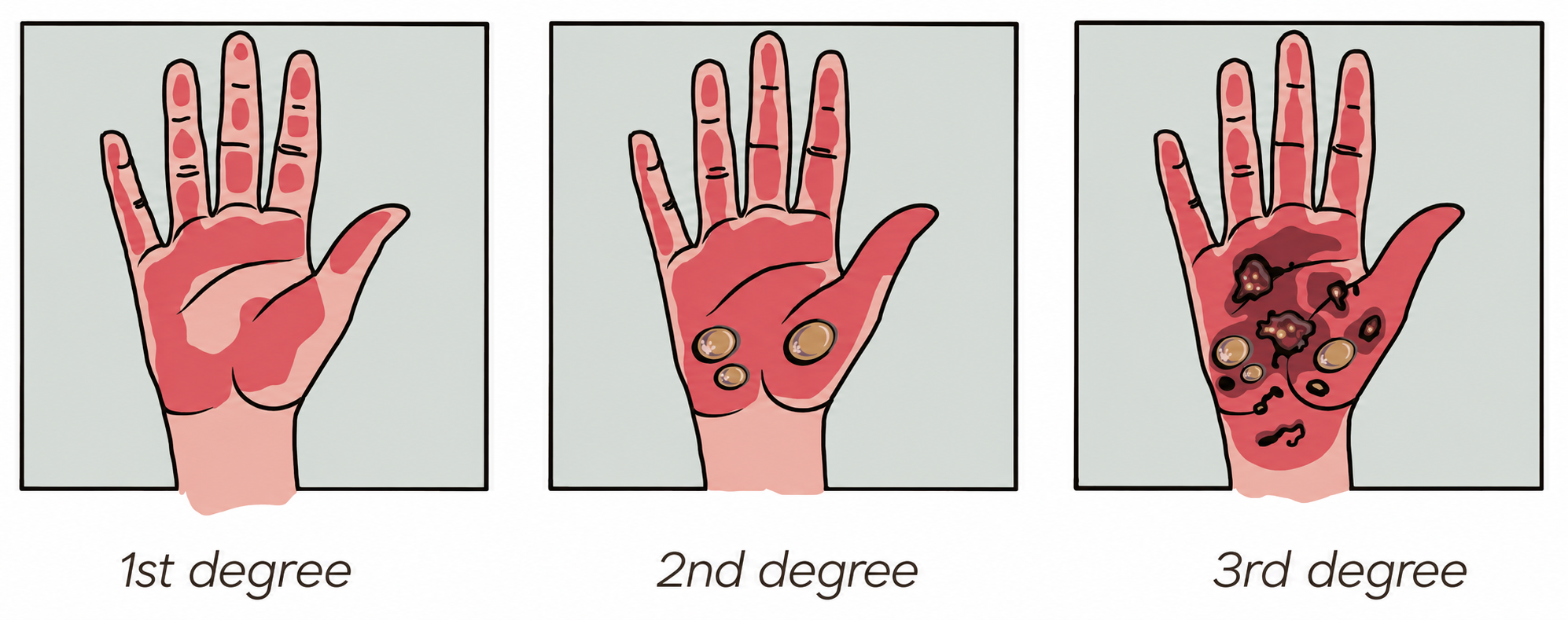 Degrees of burn injury.
Sun-related illness and heatstroke
- Cause: prolonged sun or heat exposure; heatstroke occurs when the body can no longer control its temperature.
- Signs: headache, nausea, dizziness, a hot head or skin and rapid breathing. Confusion, collapse, seizures or a very high temperature suggest heatstroke.
- Action: move the person into shade or a cool place, remove unnecessary clothing and begin cooling. Give water only if they are fully alert and can swallow. Suspected heatstroke is an emergency: call 144 immediately and continue cooling. If unresponsive, check breathing and follow the dispatcher’s instructions.
 Sun-related illness and heatstroke.
Hypothermia
- Cause: excessive cooling, for example through wet clothing, wind or being trapped in snow.
- Signs: shivering, cold skin, tiredness or confusion; severe hypothermia can reduce consciousness and breathing.
- Action: seek urgent medical help. Shelter the person, gently remove wet clothing and insulate them with dry layers or blankets, including underneath. Give a warm non-alcoholic drink only if fully awake and able to swallow. Do not massage or rub them or force them to exercise. Hypothermia can occur well above freezing, especially in wet clothing.
Frostbite
- Cause: insufficient protection of exposed areas such as fingers, toes, nose or ears.
- Signs: pain, numbness, pale skin and sometimes blisters.
- Action: address any hypothermia and seek medical help. Rewarm gently only if refreezing can be prevented, following medical advice. Protect the area with a loose dressing and do not rub it.
Never burst frostbite blisters.
Nausea and vomiting
- Cause: overexertion, overeating, flu, concussion or spoiled food.
- Signs: nausea, vomiting, weakness and cold sweats.
- Action: allow rest and offer fluids and, if tolerated, light food such as lukewarm tea and rusks. Only give food or drink if the person is fully alert and can swallow.
Diarrhoea
- Cause: irritation of the bowel by infection, allergy or spoiled food.
- Signs: diarrhoea, weakness and cold sweats.
- Action: encourage drinking and avoid fatty foods. Bananas or grated apple may be suitable foods.
Bladder infection
- Cause: a bacterial urinary-tract infection.
- Signs: painful and frequent urination.
- Action: if otherwise reasonably well, the person should drink regularly. Pain relief may help when suitable. Seek medical advice for fever, blood in the urine, severe pain or pain in the side.
Water emergencies
Use the look–think–act approach for water emergencies too.
First: do not put yourself in danger. Call for help, reassure the person from the bank and try to throw them a flotation aid. The safest rescue avoids the rescuer entering the water.
Reaching from safety or using a suitable boat may be options for trained rescuers. Swimming out is a last resort for someone with appropriate lifesaving training and a suitable flotation aid. Do not let an untrained rescue create a second casualty. Bring the person ashore safely and give first aid following the emergency dispatcher’s instructions.
Take care: cold water makes you lose strength much faster. Learn rescue techniques and how to deal with a drowning person from a qualified lifesaver on an SLRG course.
 Helping a person in difficulty in the water.
Caring for Someone Who Is Hurt or Ill
Treat injured or ill people with care and respect. Remember that you may need help one day too. Treat others as you would like to be treated.
- Never give food or drink to someone who is drowsy or unconscious.
- Make your presence known as you approach. Do not approach silently or from behind.
- Do not step over or lean across an injured or ill person. It is unpleasant and you might stumble.
- Speak to them even if they are unconscious. You do not know what they can hear, and talking may calm you too.
- Help them sit or lie down and prevent a fall.
- Protect them from heat, cold and wet. Keep them appropriately warm and shield them from onlookers.
Medical Help
Remember that, as a helper, you can and should ask for support. Without further training and suitable equipment, there are limits to what you can do.
Seek medical help in these situations:
- If you are unsure
- A life-threatening situation
- An unconscious person
- Large or severely inflamed wounds
- Bite or puncture wounds
- Suspected concussion
- A severe allergic reaction with breathing difficulties or a widespread rash
- Extensive burns or burns over joints, on the face or on the genitals
- Suspected dislocations, fractures or torn ligaments
- Poisoning
- Shock
- Severe earache
- An object in the eye that cannot be rinsed out
- Fever above 38°C lasting more than three days, or high fever above 40°C
- Electrical accidents
- Persistent symptoms
Remember: not everything can be treated at camp. Ask a medical professional once too often rather than once too little. Call 144 for an emergency.
Dressings and Bandages
Use only clean, dry materials for dressings and bandages. Put only sterile dressings directly on open wounds. Apply bandages so they do not slip, working towards the heart. Do not make them so tight that they restrict circulation. Check and replace them at least daily, or as medically advised.
 An adhesive plaster.
Plasters and adhesive dressings
Plasters easily cover small wounds. Clean the surrounding skin so they stick properly. For curved areas such as fingertips, elbows or the chin, small triangular cuts in the adhesive ends help a plaster fit the shape.
Neckerchief and triangular bandages
 An arm sling made with a triangular bandage.
Arm sling
Tie the two pointed ends behind the neck with a reef knot. The elbow should sit near the third corner. Knot that corner or fasten it with a safety pin to stop the arm slipping out. Keep the elbow at a right angle, with the arm close to the body and well supported.
Head bandage
Place the long edge across the forehead and drape the triangular bandage over the head. Tie the pointed ends behind the head. Fold the long edge if the head is small. This can also be used as a sun covering.
 A triangular head bandage.
Figure-of-eight bandage
A figure-of-eight bandage can cover or support arms and legs. Examples follow.
Elbow or knee bandage
This bandage covers or supports a joint without restricting movement too much. Use a bandage 5–8 cm wide.
 Figure-of-eight elbow bandage.
 Figure-of-eight arm bandage.
Ankle bandage
An ankle bandage supports a sprained or overstretched joint. Use a bandage 5–8 cm wide.
 Figure-of-eight ankle bandage.
Pressure bandage
A pressure bandage is used for heavy bleeding. Put on gloves first and call for emergency help when bleeding is severe.
Place a sterile dressing over the wound. Wrap the bandage firmly around the injured part a few times, then add a pressure pad over the wound, such as a packet of tissues or a tightly folded neckerchief. Secure it with the rest of the bandage. If bleeding continues, maintain direct pressure and add further padding as directed by the emergency dispatcher.
 Applying a pressure bandage.
First-Aid Kits
Carry an appropriate first-aid kit on every activity and camp. A camp kit is more comprehensive than a patrol kit. Check, replenish and renew all kits regularly. Use a clearly identifiable, closable and preferably waterproof container, protected from sunlight. You can use consumables such as plasters, bandages and disinfectant when needed. Tell the person responsible whenever you take something. Medicines should only be given by leaders, with parental consent and in accordance with the relevant instructions. The following illustrations show the main contents of patrol and camp kits.
Patrol first-aid kit
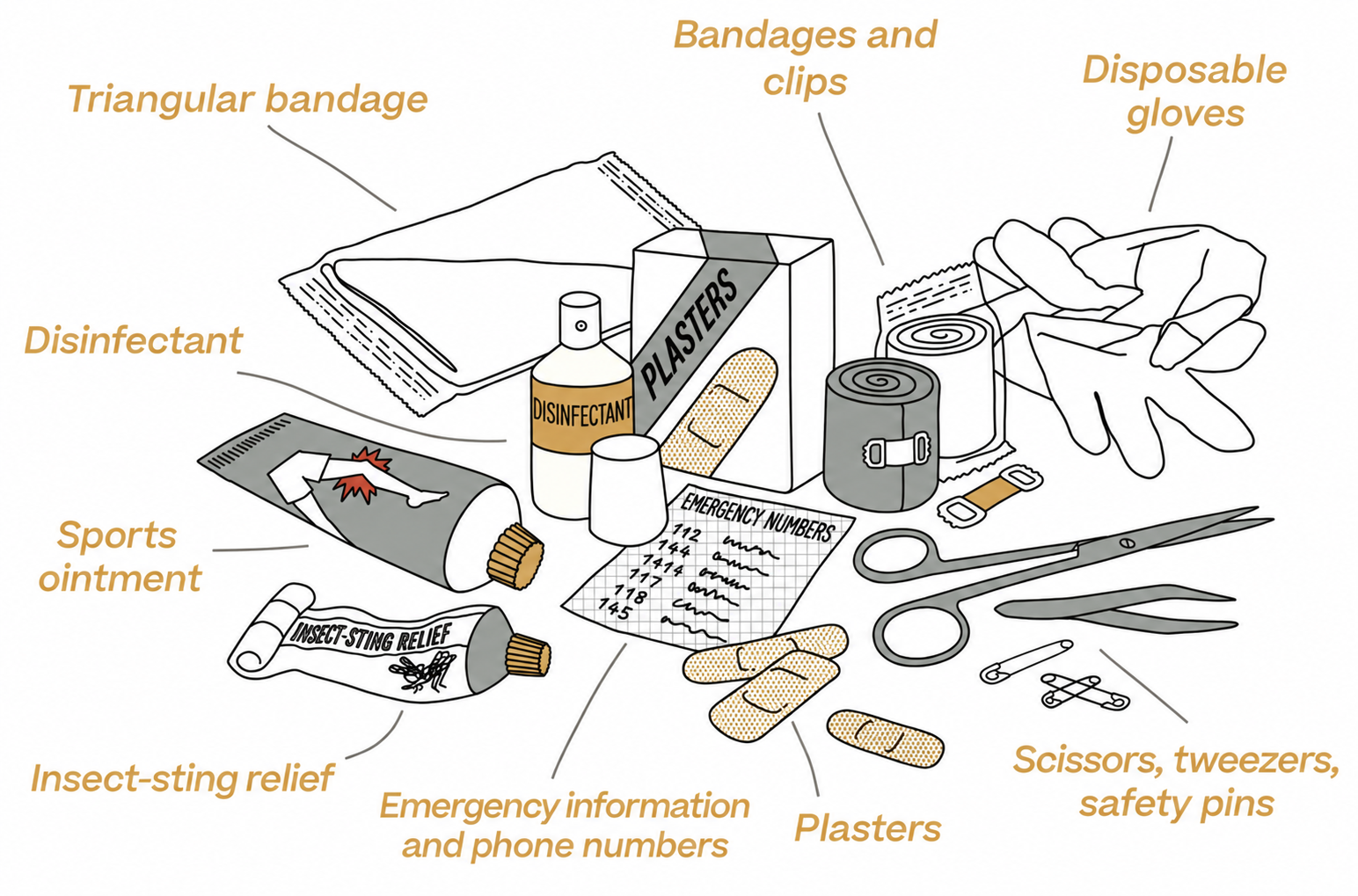 Contents of a patrol first-aid kit.
Camp first-aid kit
In addition to the patrol kit, the camp kit contains:
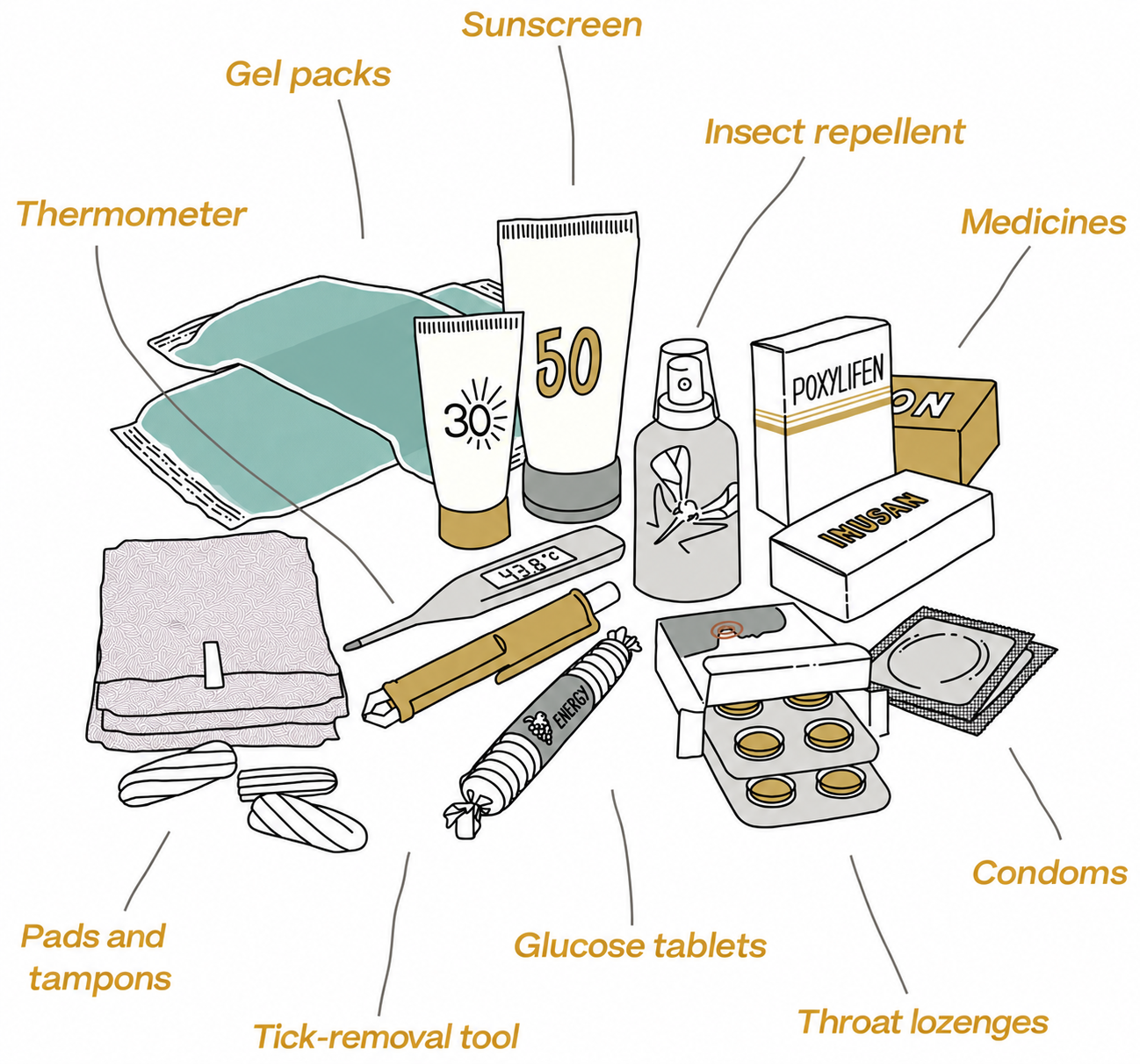 Additional contents of a camp first-aid kit.
Hygiene and Health
Hygiene
Following hygiene rules makes illness less likely to spread. Every Scout and Guide can help, including you.
- Wash your hands regularly, especially before cooking and eating and after using the toilet.
- Do not keep perishable food in a dormitory or sleeping tent.
- Drink only safe water. Water from streams needs suitable treatment, such as boiling or an appropriate filter. Do not drink untreated water from lakes, ponds or sources in livestock grazing areas: it may contain pathogens.
- Change clothes regularly, particularly when dirty.
- Wear different clothes for sleeping from those you wear during the day.
- Wash regularly and shower at least once a week.
Menstruation
- Pack supplies such as pads, tampons or a menstrual cup just in case. You can also ask your leaders: every camp first-aid kit should contain supplies.
- Wash your hands thoroughly before and after changing menstrual products.
- Tell your leaders if soap, disinfectant, disposal bags or other toilet supplies are missing.
- Carry hygiene bags so you can put waste in a bin when out and about. Leave nothing in the woods.
- Tell your leaders if you have cramps or pain. A warm hot-water bottle or suitable medicine may help.
Health
Look after yourself and your wellbeing, and keep an eye on your fellow Scouts and Guides too.
- Get enough regular sleep.
- Eat regular, balanced meals.
- Drink enough throughout the day.
- Take enough breaks.
- Dress for the weather and the activity.